Spot Fake Autographs: Common Forgery Warning Signs
July 9, 2026 · 5 min read · By BGLAD
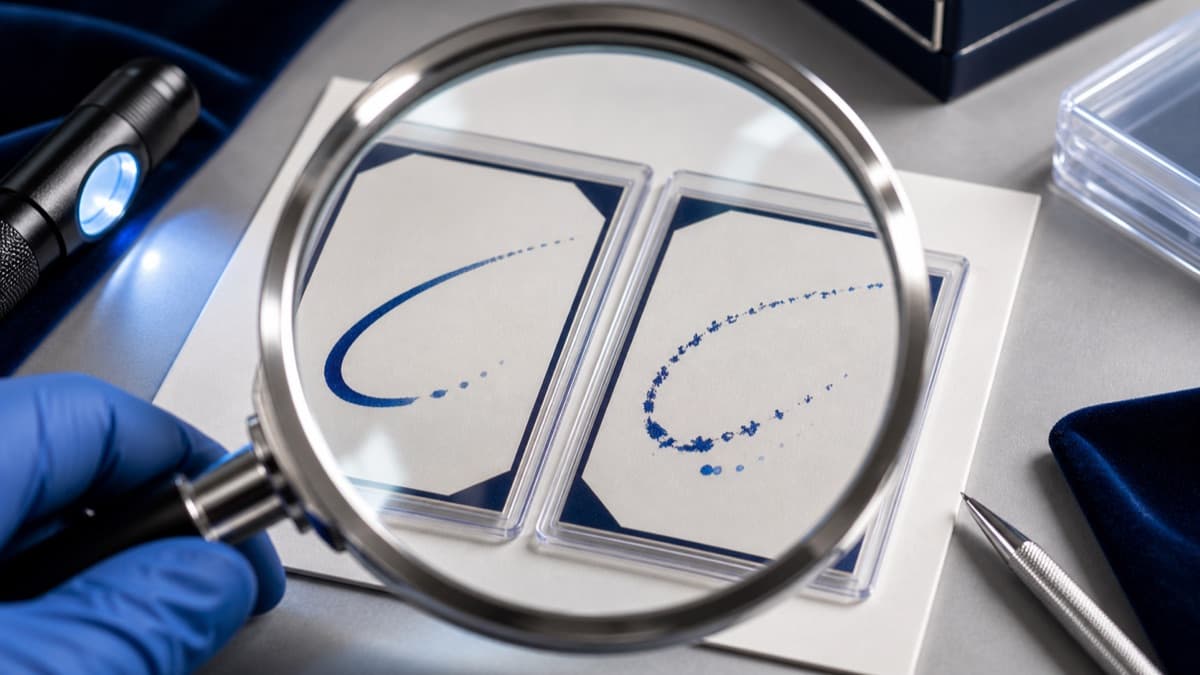
To spot fake autographs, start by looking for unnatural writing, wrong materials, weak provenance, copied patterns, and listing language that asks you to trust a story instead of evidence. No single check proves everything, but a disciplined review can help you avoid obvious problems before money changes hands.
We do not expect every collector to become a professional authenticator. We do expect collectors to slow down, compare carefully, and know when an item needs a stronger opinion than a seller's confidence.
First-pass checks to spot fake autographs
Start with the whole item, not just the ink. Ask whether the object makes sense for the signer, era, and signing setting. A modern marker on an old item is not automatically wrong, but every mismatch deserves attention. A signature placed awkwardly, squeezed into a strange area, or written over damage can also be a clue that the item was signed later under questionable circumstances.
Look at the seller's claim. Strong listings show clear photos, describe authentication status, name the item accurately, and avoid pressure. Weak listings lean on phrases like estate find, guaranteed authentic, or obtained in person without giving enough support. A story can be true, but it is not a substitute for evidence.
The same caution applies online as it does with cards. Our guide to buying sports cards online safely covers habits that carry over well: inspect photos, understand return terms, save the listing, and do not let urgency replace judgment.
Forgery tells in ink, flow, and placement
Many poor forgeries look drawn instead of written. Real signatures usually have rhythm. The pen moves with confidence, slows naturally at turns, and lifts in places that make sense for the signer. A forgery may show hesitation, tremors, blunt starts and stops, uneven pressure, or careful tracing where the writer is copying shapes instead of signing.
Speed matters, but it is not simple. Some authentic signatures are messy because the signer was moving quickly. Some forgers try to fake speed by making the signature sloppy. The question is whether the line quality looks like natural handwriting from that person or a performance by someone trying to imitate it.
Placement can tell a story too. A signature that avoids printed areas, lands in a standard signing window, or follows known signing habits may feel more natural. A signature that cuts through an odd part of a photo or sits where no collector would normally ask for it is not automatically fake, but it should make you ask why.
- Hesitation: slow, shaky lines where a real signature would usually flow.
- Wrong pressure: heavy starts, carved-looking strokes, or uneven ink that suggests tracing.
- Bad proportions: letters that match one exemplar in shape but not in spacing or scale.
- Awkward placement: signatures positioned where they display poorly without a good reason.
- Too-perfect matching: repeated signatures that line up suspiciously with another example.
Preprint, stamp, and autopen autograph clues
Not every fake autograph is a hand-drawn forgery. Some items are preprints, meaning the signature is part of the printed image. Others are rubber stamps or machine-applied signatures. These can fool collectors when photos are small or when a seller uses soft lighting to hide the surface.
Tilt the item if you can inspect it in person. Real ink usually sits differently from printed ink and may show texture, reflectivity, or pressure. A preprint will often have the same finish as the photo or card image. A stamp can have pooling at the edges, flat pressure, or repeated defects. An autopen may show mechanical starts, stops, and repeated patterns.
Our autopen signature guide explains machine and stand-in signatures in more detail. The key point here is disclosure. A preprint or autopen may have a place as a curiosity, but it should never be sold as a hand-signed autograph.
Comparing autograph exemplars without fooling yourself
Exemplars are known or believed genuine signatures used for comparison. They are useful, but only when you compare thoughtfully. Do not grab one image from the internet and expect every real signature to match it exactly. Athletes change signatures over time, sign differently in rushed settings, and may use short forms on some items.
Use multiple exemplars from similar eras and item types when possible. A sit-down paid signing may produce cleaner signatures than a quick stadium autograph. A full-name autograph may not compare well with a rushed initials-only version. Compare letter construction, spacing, slant, rhythm, and pen movement instead of only asking whether the autograph looks close.
Also consider the source of the exemplar. An authenticated item from a recognized company is usually a better comparison point than a random image with no context. Even then, authentication is an opinion, so use exemplars as evidence rather than a shortcut.
When to get an autograph authentication opinion
If the autograph is expensive, important to your collection, difficult to replace, or something you may sell later, a third-party opinion often makes sense. Authentication does not guarantee perfection, but it gives future buyers a common reference point and reduces the need to rely only on your judgment.
There are also times to walk away instead of paying for an opinion. If the price only makes sense if the autograph is real, the seller has poor photos, and the story is thin, the risk may already be too high. A bargain that requires every assumption to go your way is not really a bargain.
Our autograph authentication explained guide covers how major authenticators evaluate signatures. When bidding through our auctions, we still recommend reading the full description and checking the authentication status instead of assuming every signed item carries the same level of support.
Common questions about fake autographs
Can a certificate of authenticity be fake? Yes. A COA is only as useful as the company, event, or seller behind it. Check the number, database, item description, and reputation before treating paperwork as proof.
Are all unauthenticated autographs fake? No. Many real autographs are raw, especially personal keepsakes, older collections, and in-person items. Raw just means the buyer has to price the uncertainty and do more homework.
What should you do if you already bought a questionable autograph? Preserve the listing, receipt, photos, and messages. Compare the item carefully, consider a professional opinion, and if the seller misrepresented it, use the marketplace's return or dispute process within the allowed window.
Ready to hunt?
Graded slabs, sealed boxes, and live auctions — verified and insured.